
Why Your Kitchen Needs a Vedic Makeover?

Walk into a typical Indian kitchen today and you’ll usually find three things on repeat: refined oil, refined sugar, and “regular” ghee or butter.
They’re convenient, cheap and everywhere—but they’re also some of the biggest reasons our plates have drifted away from what our bodies actually need.
At the same time, lifestyle diseases like obesity, diabetes and heart problems are on the rise in India, and most experts point to excess refined sugar and highly processed fats as major contributors.
That’s exactly where a Vedic-style kitchen comes in—built on A2 desi cow ghee, pure raw honey, traditional jaggery and cold-pressed oils. These are not “trendy superfoods”; they’re the same staples your dadi and nani trusted, now backed by modern nutrition research.
In this article, we’ll break down why switching your staples can be the single smartest upgrade for your family’s everyday health—and how Vedik Tattva’s range of A2 ghee, honey, jaggery and oils can help you make that shift effortlessly.
The Problem with Today’s “Modern” Kitchen
Most of us grew up thinking:
“Oil is oil, ghee is ghee, sugar is sugar… what’s the big difference?” But there’s a huge difference in how your body responds to:
- Refined vegetable oils vs. cold-pressed oils
- Regular ghee vs. A2 desi cow ghee
- White sugar vs. raw honey & traditional jaggery
Refined oils – plenty of marketing, not much goodness
Refined oils are often extracted using high heat and chemical solvents, then bleached and deodorised to look and smell “neutral”. In the process, they lose many of the natural antioxidants and micronutrients present in the original seed or nut.
Cold-pressed oils, on the other hand, are extracted mechanically at lower temperatures, which helps retain more of the natural flavour, aroma and heat-sensitive nutrients.
Refined sugar – sweet taste, empty calories
Refined white sugar gives instant energy but virtually no nutrients. Studies and expert reviews consistently point out that high intake of added sugar is linked to weight gain, insulin resistance and metabolic issues, making it a major risk factor for type 2 diabetes and other lifestyle disorders.
That’s why nutritionists increasingly suggest switching at least part of your sugar intake to more traditional sweeteners like jaggery and raw honey—not because they are “magic foods”, but because they’re less processed and offer trace nutrients when used in moderation.
A2 Desi Cow Ghee: Liquid Gold for Digestive & Immune Health
If there is one ingredient that truly deserves the phrase “Vedic superfood”, it’s A2 desi cow ghee.
What makes A2 ghee different from regular ghee?
Ghee can be made from milk of any cow, but A2 ghee is traditionally made from Indian breeds like Gir, Sahiwal, Red Sindhi etc. These cows naturally produce A2 beta-casein protein, which emerging research suggests may be easier to digest than A1 protein from many crossbred or exotic breeds.Honey and Spice+1
Loaded with fat-soluble vitamins and good fats
High-quality A2 ghee is a rich source of:
- Vitamin A, D, E and K – crucial for immunity, bone strength, skin and cellular health
- Omega-3 and other healthy fats – support heart health and hormone balance
- Conjugated Linoleic Acid (CLA) – associated with metabolic support
- Butyric acid – a short-chain fatty acid that nourishes the gut lining and supports digestive healthBharat Vedica+5Parsi Dairy Farm+5Yellow Heart Oil+5
That’s why many Ayurvedic traditions recommend a spoon of ghee with warm food to:
- Aid digestion
- Support gut health
- Improve absorption of fat-soluble nutrients
Everyday ways to use A2 ghee
Small changes can make a big difference:
- Drizzle A2 ghee over hot dal or khichdi instead of refined oil
- Use it to fry your tadka instead of refined vegetable oil
- Add a small spoon of ghee to your child’s roti or rice for balanced energy
- Use it in halwa, laddoos and baking as a more traditional fat than margarine or shortening
Vedik Tattva Tip:
Replace just one refined fat per day with A2 ghee and notice how your meals feel lighter on digestion yet more satisfying.
Honey & Jaggery vs Sugar: A Smarter Way to Sweeten (In Moderation)
Let’s be honest: nobody is giving up sweetness completely. The question is how you sweeten your life.
Jaggery – not just “brown sugar”
Traditional jaggery (gur) is made by boiling sugarcane or palm sap without the heavy refining that white sugar undergoes. Because it is less processed, jaggery retains small amounts of minerals like iron, potassium, magnesium and calcium, as well as natural plant compounds. Nutritionally, it’s still a sweetener and contributes calories—but compared to sugar, good-quality jaggery:
- Is less processed
- Often has a slightly lower glycaemic index than refined sugar in some studies
- Fits beautifully into traditional Indian recipes (from chikki to kheer)
Raw honey – nature’s complex sweetener
Raw honey doesn’t just bring sweetness; it also offers:
- A small amount of vitamins and minerals (like potassium, iron, calcium)
- Natural antioxidants and plant compounds
- A slightly lower glycaemic index than sugar, meaning a gentler rise in blood sugar for most peopleEatingWell+1
Modern nutrition experts caution that honey is still an added sugar and should be taken in moderation—but when you’re reaching for something sweet, raw, unadulterated honey is usually a better choice than refined white sugar.
Jaggery & honey: how realistic is the swap?
Instead of thinking “jaggery and honey are healthy, so I can eat unlimited amounts”, think in terms of:
- Swap, don’t stack. Replace part of your daily sugar with jaggery or honey, don’t add them on top.
- Use jaggery in your chai or desserts instead of sugar.
- Sweeten your lemon water or herbal tea with a small spoon of honey instead of sugar-laden syrups.
- Try traditional recipes like til-gud, panjiri or gond laddoos that naturally use these sweeteners.
Vedik Tattva Tip:
Create a blog CTA section like:
Cold-Pressed Oils: Going Back to the Wooden Ghani Mindset
If you grew up seeing your grandparents talk about “kachchi ghani ka tel”, they were already referring to what we now call cold-pressed oils.
Why cold-pressed matters
Cold-pressed oils are extracted:
- Using mechanical pressure instead of high heat
- Without harsh chemical solvents
- At temperatures that help preserve natural antioxidants, aroma and flavour
Brands promoting cold-pressed oils highlight that these methods better retain heat-sensitive phytochemicals and nutrients, making them closer to traditional village-style extraction.
Where they fit in your kitchen
Different cold-pressed oils shine in different cuisines:
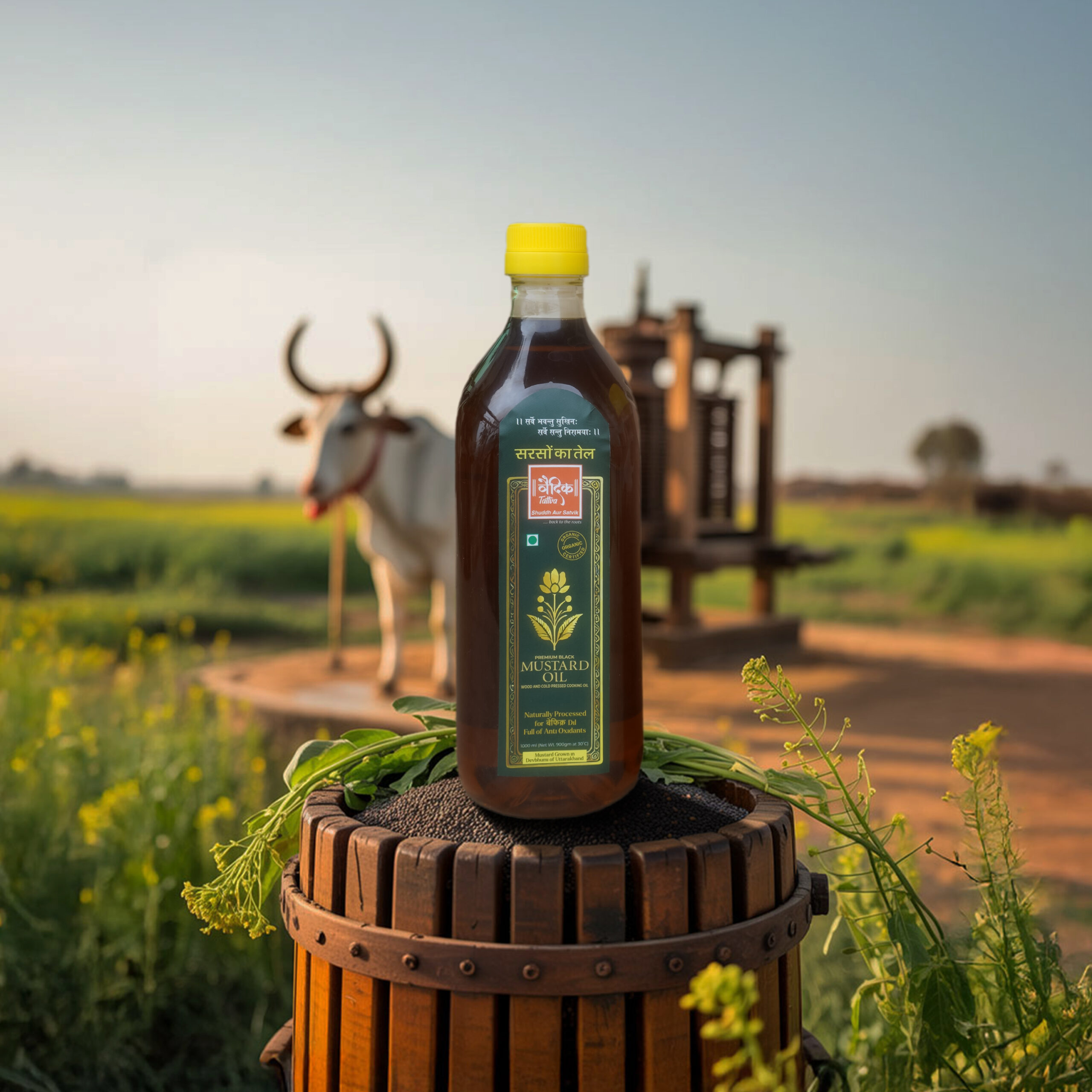
- Cold-pressed mustard oil – fantastic for North Indian cooking, pickles, curries
- Cold-pressed sesame oil – ideal for certain South Indian dishes, stir-fries, traditional remedies
- Cold-pressed groundnut oil – great for everyday frying at appropriate temperatures
Instead of one generic “refined oil for everything”, think of having 2–3 traditional oils and using them as per cuisine and cooking style.
Building a “Vedik Tattva” Kitchen: Practical Swaps You Can Start Today
You don’t need to flip your kitchen overnight. Start with small but consistent changes.
Simple starter swaps
- On your roti / rice
- Swap refined oil or regular butter with A2 desi cow ghee.
- In your morning tea / coffee
- Reduce sugar by half; replace a portion with jaggery.
- In your halwa / sweets
- Use A2 ghee + jaggery or honey instead of refined oil + white sugar where recipes allow.
- For everyday cooking
- Gradually move from a single refined vegetable oil to cold-pressed mustard / groundnut / sesame oil, based on your region and taste.
What to look for when choosing a brand
When you’re buying these staples, keep a checklist:
- Source transparency – Is the brand clear about where its ghee, honey and jaggery come from?
- Minimal processing – Words like “cold-pressed”, “wood-pressed”, “traditional method” vs “refined, bleached, deodorised”.
- Additive-free – No artificial colours, flavours or unnecessary preservatives in basic staples.
- Lab testing for purity – Especially important for honey and oils due to adulteration in the market.
You can frame Vedik Tattva’s USPs here in bullets – e.g.
- Traditionally prepared A2 desi cow ghee
- Carefully sourced honey and jaggery
- Cold-pressed oils staying close to Vedic kitchen principles
Important Reality Check: “Natural” ≠ “Unlimited”
There’s one crucial point every responsible brand must make clear:
- Jaggery, honey and ghee are still calorie-dense foods.
- Overeating anything sweet or fatty—natural or not—can contribute to weight gain or blood sugar spikes, especially in people with diabetes or metabolic issues.
The real power of a Vedic-style kitchen isn’t that you’re eating unlimited traditional foods; it’s that you’re eating:
- Better quality ingredients
- In more mindful quantities
- With less ultra-processing and chemicals
- In tune with what Indian bodies have adapted to over generations
The Takeaway: Small Vedic Choices, Big Modern Benefits
You don’t need a complicated diet or imported “superfoods” to support your health.
If you simply:
- Cook more often in A2 desi cow ghee and cold-pressed oils
- Replace a part of your refined sugar with jaggery and raw honey (in moderation)
- Choose brands that respect Vedic principles of purity, simplicity and balance
…you’ve already made one of the most meaningful upgrades possible to your family’s everyday food.